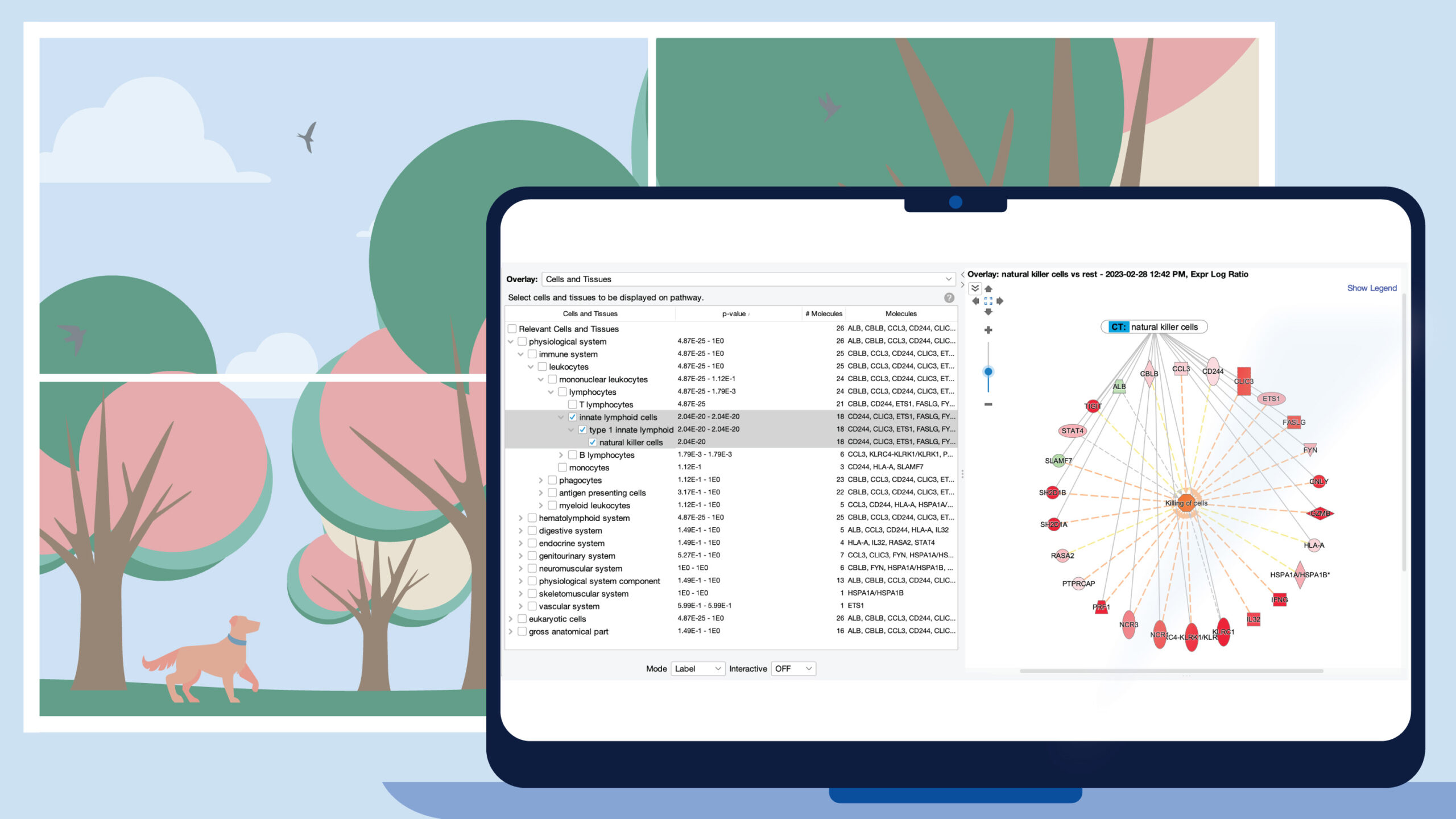

















QIAGEN Discovery Platform

The data foundation for explainable AI drug discovery

Explore the full-stack platform for drug discovery, built on structured biological data.

Create explainable AI (XAI) with trusted data

QIAGEN Discovery Platform brings together biomedical knowledge and AI agents into a single, cohesive ecosystem. It provides a universal semantic layer that empowers a modular system of agents all drawing from the same source of biological reality.

Move beyond pattern recognition, avoid shallow answers and reduce hallucinations with the structured causality your models need.

Live event
April 24, 2026
10:00 AM EDT
Reduce discovery risk with comorbidity data & knowledge graphs
Meet QIAGEN Discovery Platform – where complex data becomes breakthrough insights. We'll uncover the shared mechanisms driving comorbidity between asthma and irritable bowel disease.
Join us

Data

Biological context

Understand the context that creates complex biological interactions and affects their outcomes

Depth

Explore data from published research and public databases

Reliability

Anchor your LLMs in quality data, curated with human expertise and reasoning

Knowledge Graph

Expansive

Discover unexpected connections and create new hypotheses

Integrated

Connect your existing data to our curated genes, proteins, pathways, diseases and drugs

Flexible

Add new data as scientific knowledge progresses and you make more discoveries

Applications

Build profiles

Create profiles of diseases, phenotypes and biological processes, including associated genes and compounds

Make connections

Find causally relevant genes and explore associations with similar diseases or phenotypes

0M+
curated biological findings
0M+
graph relationships
0+
years of experience
10000+
citations in literature

Made for your AI workflow

QIAGEN Discovery Platform provides a single, unified source of large-scale biomedical data for mechanistic reasoning and auditable agentic workflows.

Create a custom semantic layer for your AI agents that combines your internal data and our high-quality data into biological truth.

Data Engineers

Integrate one traceable knowledge graph into your infrastructure, reducing complexity and points of failure

Data Scientists

Improve model confidence with mechanism-based prioritization, pathway scoring and interpretable GraphRAG

AI/ML Product Teams

Develop scalable, auditable XAI applications based on structured biological knowledge

How to close the loop

Create reliable insights from reliable data.

A single layer for large-scale evidence

Start every project from the same canonical, standardized source for biological reality
Explore pathway activity, genes, variants, proteins, phenotypes and more with directionality and context
Trace every data point back to verified sources like Nature, Science, PubChem and more

Reproducible, auditable workflows

Prioritize and rank models with explainable rankings based on biomedical data
Make informed decisions based on causality and context
Build on a stable, enforceable ontology that makes governance easy

What's new

QIAGEN Discovery Knowledge Base, the foundation of QIAGEN Discovery Platform, includes expanded data coverage, improved access and enhanced consistency across representations. 
Explore all updates

What’s new in the QIAGEN Discovery Knowledge Base and Discovery KB+ 2026.1 release

Software and documentation changes
  • Biomedical Knowledge Base is evolving into Discovery Knowledge Base (Discovery KB or DKB)
  • Python and R clients have been updated to reflect this change
  • The REST API endpoint address has been updated to reflect this change
  • New Python and R clients must be used to access the latest data version via the API
  • Updated tutorial and webinar notebooks with fixes
Representation changes
  • Neo4j-bio representation
    • The "curation" attribute for interaction edges was renamed to "data_acquisition_method"
  • Tabular representation
    • Filled in missing values in the "relationship_type_category" column
    • The "project_start_date" and "project_end_date" columns in the "sources" table are now typed as DATE
Content changes
  • Coverage
    • Added NLP-processed relationships from FAERS, patent, grant and publication sources
    • These relationships are marked as "AI Automated Review Findings" under the "data_acquisition_method" property
    • Added 9 ontology nodes that were previously cited but not described in the content
    • Added primary references to finding metadata for a subset of ClinVar findings which previously included only secondary references
    • Added localization values under "relationship_type" for gene location relationships that previously did not include
  • Naming
    • The "synonyms" table now includes acronyms for entities
    • The "variation_metadata" content now includes mapping of variants to dbSNP IDs
    • 700 new "Biocrates_id" values were included
  • Alignment and integration
    • Eliminated a small number of redundant names for cell types
    • Corrected redundant descriptions of metadata for 50 findings
    • Corrected 16 pathway nodes by restoring unintentionally omitted content
    • Corrected overlap between "process_property" and "variation_type"
    • Made minor fixes to property descriptions
    • Reduced the number of molecule nodes where n > 1 for "high_level_node" by 50%

Explore the future of drug discovery

Scale high-impact biomedical applications, train robust XAI models and unlock new therapeutic opportunities with QIAGEN Discovery Platform.
Join over 40,000 researchers already using our data.
Sample to Insight
coguserscalendar-fullclockchevron-rightcheckmark-circlelayers linkedin facebook pinterest youtube rss twitter instagram facebook-blank rss-blank linkedin-blank pinterest youtube twitter instagram
This site is registered on wpml.org as a development site. Switch to a production site key to remove this banner.